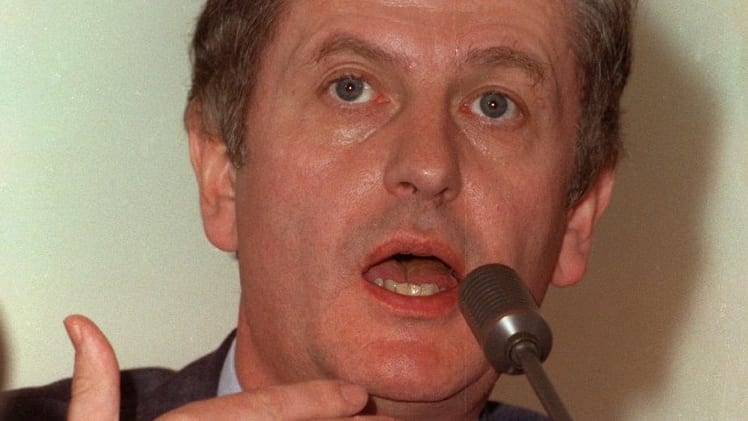
Room 317: Unraveling the Mystery of Uwe Barschel's Death
In the annals of German political history, few events are as shrouded in mystery and controversy as the tragic death of Uwe Barschel. A rising star in the Christian Democratic Union (CDU), Barschel’s promising career culminated in a scandal of unprecedented proportions – the Uwe Barschel: The 'Ehrenwort' Scandal That Shook 80s Germany – which ultimately led to his demise under circumstances that continue to baffle investigators and the public alike. Room 317 of the Hotel Beau-Rivage in Geneva became the focal point of this enduring enigma, a place where a political drama reached its grim and ambiguous conclusion.
Thirty-seven years later, the question lingers: Was it suicide, driven by the immense pressure and disgrace of the allegations, or was it something far more sinister? The Uwe Barschel: Dirty Tricks, Political Downfall, and Unanswered Questions surrounding the case have fueled endless speculation, highlighting the darker side of political power and the often-unseen battles fought behind closed doors.
The Tumultuous Prelude: A Political Career Undone
The saga began on September 12, 1987, when a preliminary report from NDR II radio alerted the public to an impending exposé in "Der Spiegel" magazine. The report detailed shocking allegations against Uwe Barschel, then the Minister-President of Schleswig-Holstein. He was accused of orchestrating "dirty tricks" to undermine his Social Democratic Party (SPD) challenger, Björn Engholm. These alleged tactics included commissioning the spying of Engholm and dictating an anonymous complaint accusing him of tax evasion.
The foundation of these explosive claims was a 22-page sworn affidavit from Reiner Pfeiffer, a former media consultant in Barschel's Kiel State Chancellery. Pfeiffer had delivered his testimony to a Hamburg notary on September 9 and subsequently vanished, leaving a trail of unanswered calls and growing suspicion. As more details from Pfeiffer's statement became public, Barschel's initial dismissals turned into palpable nervousness. While he claimed this was not due to fear of "revelations," the timing was critical: state elections were just a day away.
Barschel quickly called a press conference, vehemently denying the accusations as "foul and fabricated." However, his denials failed to quell the storm. The following day, his CDU party suffered a significant loss, dropping six percentage points. The defining moment of the Uwe Barschel: The 'Ehrenwort' Scandal That Shook 80s Germany arrived on September 18, when Barschel, at another press conference, declared: "Beyond these sworn affidavits that I will present to you shortly, I give you, I give the citizens of the state of Schleswig-Holstein and the entire German public my word of honor – I repeat: I give you my word of honor! – that the accusations leveled against me are baseless."
This "Ehrenwort" (word of honor) became his undoing. It was soon revealed that at least some of the allegations were true, and the affidavits Barschel presented were insufficient to refute Pfeiffer's detailed account. On September 12, 1987, the political career of Uwe Barschel, a man once considered a potential future Chancellor, effectively ended. Barschel, born in 1944 and a war orphan who grew up in a refugee home, was known for his ambition, even causing a scandal as a student by inviting Hitler's successor, Karl Dönitz, to his gymnasium.
The Grim Discovery in Room 317
Less than a month after his infamous "Ehrenwort," Uwe Barschel was found dead. The scene of this tragic discovery was Room 317 of the Hotel Beau-Rivage in Geneva. On October 11, 1987, at 12:43 PM, "Stern" reporter Sebastian Knauer entered the room, ignoring the "Do Not Disturb" sign on the doorknob. The room was darkened, a somber atmosphere preceding a chilling revelation.
Knauer observed a tied-up black men's shoe in the hallway, a folded pajama on the bed, and a German edition of Jean-Paul Sartre's collected stories. Armed with a small camera, he proceeded to the bathroom. What he found there would become one of the most iconic and disturbing images in German media history: Uwe Barschel, fully clothed, submerged in a bathtub filled with water. The immediate conclusion drawn by investigators and the media was suicide, an understandable assumption given the immense political and personal pressure Barschel had endured.
This discovery sent shockwaves across Germany and beyond. The image of the deceased politician in Room 317 cemented the Uwe Barschel: Dirty Tricks, Political Downfall, and Unanswered Questions as not just a political scandal, but a profound human tragedy. The swiftness of the conclusion, however, would later come under intense scrutiny.
The Shifting Narrative: From Suicide to Suspected Murder
While the initial assessment pointed to suicide, the ensuing years saw a persistent and growing chorus of voices questioning this verdict. What was initially considered an open-and-shut case began to unravel as new information surfaced, and forensic analyses provided conflicting evidence. Many pieces of circumstantial evidence, or "Indizien," started to suggest that Barschel's death might not have been self-inflicted.
Schleswig-Holstein's then General Prosecutor, Erhard Rex, initially remained skeptical of the murder theory, even criticizing what he perceived as a "marketing" of the alternative hypothesis. However, the sheer volume of inconsistencies and unanswered questions proved difficult to dismiss. For instance, the presence of various sedatives and hypnotics in Barschel's system, some of which he reportedly did not regularly take, raised questions about how they were administered. Moreover, the state of the hotel room itself, the absence of a clear suicide note, and Barschel's recent activities prior to his death painted a more complex picture.
The transition from a clear suicide narrative to a suspected murder theory underscores the complexities of high-profile investigations, especially when political interests are involved. Initial conclusions, often driven by a need for closure and simplified narratives, can be challenged by persistent investigative journalism and new forensic techniques. The public's demand for truth, combined with the detailed work of independent researchers and former intelligence agents, kept the murder theory alive, even in the face of official resistance.
Unanswered Questions and Enduring Legacy of the Uwe Barschel Affäre
Despite decades of inquiries, re-investigations, and extensive media coverage, the Uwe Barschel Affäre has never been fully resolved. The mystery surrounding Room 317 and the circumstances of Barschel's death continues to be a source of national fascination and academic study in Germany. The enduring questions highlight the inherent challenges in uncovering the truth when political power, personal ambition, and potentially covert operations intersect.
The case serves as a poignant reminder of the fragility of reputation and the immense pressure that can accompany a life in public service. For politicians and public servants, the Barschel Affäre stands as a stark warning about the dangers of engaging in unethical practices and the catastrophic consequences that can follow. It underscores the critical importance of integrity, transparency, and accountability in political life.
From an investigative standpoint, the case illustrates the difficulties inherent in establishing definitive conclusions years after an event, particularly when initial forensic examinations may have been incomplete or biased. The lack of a clear, universally accepted explanation for Barschel's death fuels endless debate, keeping the memory of the scandal alive and prompting ongoing discussions about the true nature of power and justice. The legacy of the Uwe Barschel Affäre is not just about a politician's downfall, but about the unresolved questions that haunt a nation's collective memory, a persistent testament to the shadows that can obscure even the most public lives.
The tragedy of Uwe Barschel's death in Room 317 remains an open wound in German political history. While the immediate cause of death might have seemed clear at the time, the subsequent unraveling of the narrative, driven by relentless scrutiny and newfound evidence, has ensured that the mystery endures. What happened in that hotel room in Geneva, after the 'Ehrenwort' shattered a career and reputation, continues to be a compelling, yet ultimately elusive, truth.