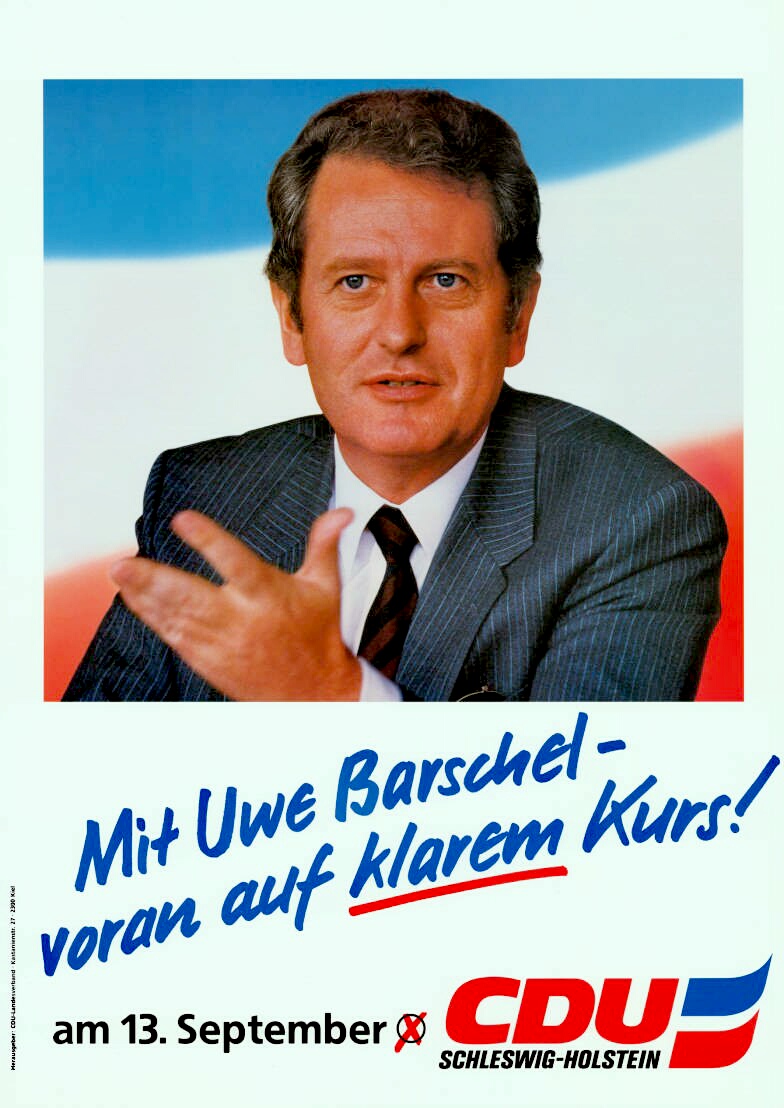
The Unraveling of a Political Star: The Uwe Barschel Affäre Begins
The year 1987 saw Germany gripped by one of its most profound political scandals, a saga that would forever be etched into the nation's collective memory: the
Uwe Barschel Affäre. At its heart was Uwe Barschel, the ambitious, charismatic Minister-President of Schleswig-Holstein and a rising star within the Christian Democratic Union (CDU), whose promising career was abruptly and tragically derailed by allegations of "dirty tricks."
The storm broke on a quiet Saturday, September 12, 1987. Shortly after 3 PM, German public radio station NDR II delivered a bombshell: the news magazine "Der Spiegel" was set to publish a damning exposé on Monday. The report detailed highly questionable methods allegedly employed by Barschel's campaign. Specifically, it claimed Barschel had personally ordered the surveillance of his Social Democratic Party (SPD) challenger and opposition leader, Björn Engholm. Furthermore, Barschel was accused of dictating an anonymous complaint to tax authorities, falsely accusing Engholm of tax evasion. This immediate, pre-publication leak sent shockwaves through the political landscape, setting the stage for a dramatic week that would culminate in a public pledge and a devastating downfall.
Reiner Pfeiffer: The Whistleblower Who Shook the System
The foundation of the "Spiegel" report was a 22-page sworn affidavit from Reiner Pfeiffer, a 48-year-old media consultant within Barschel's Kiel State Chancellery. Pfeiffer, who had been responsible for "media observation," claimed to have been directly involved in these illicit activities and decided to "come clean." He had submitted his affidavit to a Hamburg notary on September 9th and subsequently vanished, reporting himself sick from work. Calls to his apartment in Kiel and his wife in Bremen went unanswered, adding to the mystery and the palpable tension surrounding the brewing scandal. As more details from Pfeiffer's statement became public throughout that Saturday afternoon and evening, Barschel's anxiety reportedly grew. While he later claimed this was not due to fear of "revelations," but rather another pressing concern scheduled for September 13th, the weight of the allegations was undeniable.
The Fateful 'Ehrenwort': A Pledge Broken, A Career Shattered
In the immediate aftermath of the scandal breaking, Uwe Barschel swiftly convened a press conference. There, he vehemently dismissed the accusations as "foul and fabricated." However, his denial failed to resonate with the public. The subsequent state election on Sunday saw the CDU suffer a significant six percentage point loss, far exceeding expectations. The electoral setback only intensified the pressure on Barschel.
Just five days later, on September 18, 1987, Barschel held another, more dramatic press conference. It was here that he uttered the words that would define the scandal and seal his fate. After presenting what he claimed were sworn statements refuting the accusations, he looked directly at the cameras and, with an air of solemnity, declared: "Beyond these sworn affidavits, which I am about to present to you, I give you, I give the citizens of the state of Schleswig-Holstein and the entire German public my word of honour – I repeat: I give you my word of honour! – that the accusations made against me are baseless." This public pledge, the "Ehrenwort" (word of honour), was meant to be an unassailable declaration of his innocence, a definitive end to the controversy.
The Weight of Public Trust: Why the 'Ehrenwort' Was So Damning
In German culture, an "Ehrenwort" is not merely a promise; it is a solemn, deeply binding vow that invokes one's personal integrity and reputation. For a politician, to give one's Ehrenwort to the public carries immense weight, implying absolute truthfulness and a willingness to stake one's entire credibility on the statement. When it later emerged that the allegations against Barschel were, at least in part, true, and that the sworn statements he presented were themselves questionable, the impact was devastating. The betrayal of public trust inherent in a broken Ehrenwort was a monumental blow, far greater than the "dirty tricks" themselves. It shattered the public's faith in Barschel and, by extension, cast a shadow over political ethics more broadly. His once-bright political career, which many believed could have led him to the Chancellery, effectively ended on that day. For political leaders today, the Barschel Affäre serves as a stark reminder of the non-negotiable value of honesty and the profound consequences of undermining public trust, particularly when invoking such a powerful cultural pledge.
Room 317: A Tragic End and Enduring Mystery
Just four weeks after the scandal broke, the Uwe Barschel Affäre took an even darker turn. On October 11, 1987, the former Minister-President was found dead in Room 317 of the Hotel Beau-Rivage in Geneva, Switzerland. The initial conclusion by investigators and media was suicide, fueled by the immense public and political pressure he had faced. However, the circumstances of his death, shrouded in mystery and contradiction, have since led many to believe otherwise.
The discovery was made by "Stern" reporter Sebastian Knauer, who, at 12:43 PM, entered Barschel's unlocked room, ignoring the "Do Not Disturb" sign on the handle. The room was darkened. In the hallway, Knauer noticed a neatly tied black men's shoe. On the bed lay a folded pajama and a book – a German edition of Jean-Paul Sartre's collected short stories. With a small camera in hand, Knauer opened the bathroom door and found Barschel lying in a water-filled bathtub, fully clothed. The image of the deceased politician in the bathtub became an iconic and disturbing symbol of the tragic end to the Uwe Barschel Affäre, forever linking his name with Hotel Beau-Rivage's
Room 317.
Beyond the Headlines: The Lingering Questions and Theories
While the initial investigation pointed to suicide, the years that followed saw the emergence of numerous inconsistencies, new evidence, and alternative theories, casting significant doubt on this conclusion. Many believe Barschel was murdered, possibly to silence him. Speculations have ranged from foreign intelligence involvement to connections with international arms deals and money laundering, suggesting a conspiracy far wider than the political scandal in Schleswig-Holstein. Despite decades of investigations, reinvestigations, and public debate, no definitive conclusion has ever been reached, leaving the question of how Uwe Barschel died perpetually unanswered.
Even today, the case remains highly contentious. Schleswig-Holstein's general prosecutor, Erhard Rex, for instance, has openly criticized what he views as the "marketing" of the murder theory, maintaining his belief in suicide. This ongoing official stance highlights the deep divisions and lack of closure surrounding the event. The Uwe Barschel Affäre, therefore, stands not only as a political scandal but also as a enduring cold case, continuing to fuel speculation and conspiracy theories.
Lessons from the Barschel Affäre: Transparency, Trust, and the Media's Role
The Uwe Barschel Affäre offers profound lessons for modern politics, media, and public life.
*
The Primacy of Truth in Politics: Barschel's initial denials and, more critically, his broken "Ehrenwort" underscore the catastrophic consequences when political leaders mislead the public. Maintaining transparency and integrity, even in the face of damaging revelations, is crucial for preserving democratic trust.
*
Media as a Watchdog: The role of NDR II and "Der Spiegel" in breaking and pursuing the story highlights the vital function of an independent press in holding power accountable. However, it also raises questions about the ethics of news leaks and the immense power of media narratives to shape public opinion and political careers.
*
The Dangers of "Dirty Tricks": The allegations of spying and false accusations against an opponent serve as a stark warning about the corrupting influence of unethical campaign tactics. Such strategies not only harm political adversaries but also erode the very foundations of fair democratic competition. Political parties and candidates should implement strict ethical guidelines and foster cultures that discourage such practices.
*
Understanding Public Reaction: The strong public and electoral reaction to the scandal demonstrates the deep expectation citizens have for their leaders to embody honesty and decency. When these expectations are violated, the political consequences can be severe and irreversible.
*
The Enduring Impact of Unanswered Questions: The lack of a conclusive answer regarding Barschel's death has fueled decades of speculation, undermining confidence in the justice system for some and creating a fertile ground for conspiracy theories. This aspect of the
Uwe Barschel Affäre illustrates how unresolved mysteries can leave lasting scars on a nation's psyche.
For students of political science and journalism, the Barschel Affäre serves as a crucial case study in the complex interplay of power, ethics, media responsibility, and the fragility of public trust.
The Uwe Barschel Affäre remains a pivotal moment in German history, a story that encapsulates ambition, scandal, betrayal, and an enduring mystery. It continues to fascinate and prompt reflection on the ethical boundaries of political conduct and the profound impact of truth and deception in the public sphere.